The Difference Between Home and a House
Mr. & Mrs. SmithThe Difference Between Home and a House comes into focus when Jane realizes that the Smiths’ home has been reduced to rubble. The destruction strips away the things she had treated as proof of permanence and exposes a more durable meaning of home: not a building or its contents, but the life Jane and John can make together. What first appears to be the loss of everything becomes a change in what, and whom, they understand as essential.
The House as a Material Life
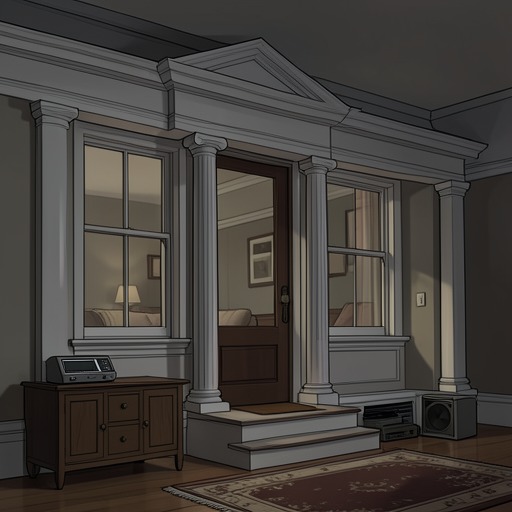
As Jane considers where to take the exhausted, wounded John, the practical question of shelter opens into a larger reckoning. Their house lies in ruins. The loss is tangible: the furniture they chose together, the ornaments and artworks, and the boxes of possessions stored in the basement are gone. Even those boxes had been arranged and alphabetized, a small image of the order Jane had tried to impose on their shared life. The destruction reaches beyond property. Jane sees that they have broken everything they built together, and, in the first shock of the moment, concludes that nothing remains.
The inventory gives the house a double meaning. These things were part of the life the couple assembled, but their careful selection and organization could not protect that life from collapse. Once the building is destroyed, its contents cease to function as the reassuring background of domestic routine. Their absence makes the material structure newly visible: a house can hold objects and embody a couple’s plans, yet it cannot by itself ensure that those plans amount to security or love.
Jane’s Ideal of Perfection
Jane connects her investment in the house to having grown up without one. She had tried to make this home look perfect, filling it with things she believed she loved. In retrospect, she recognizes that she had persuaded herself that perfection meant safety, stability, and love. The house was not simply a setting; it was the material form of a promise she hoped to make reliable.
The destruction exposes the weakness of that promise without denying the importance those possessions once seemed to have. Jane now sees the house as a collection of things, none of which was what truly mattered. The contrast is sharp: she had built a polished environment in pursuit of permanence, but the experience that clarifies her priorities comes when that environment is gone. The house’s ruin overturns her equation of material completeness with emotional security.
Home as a Shared Relation
Jane’s decisive realization is that she and John have lost their house, not their home. The distinction shifts the meaning of the loss from the disappearance of a place to the survival of a relationship. If they remain together, they can go anywhere and call it home. Home is therefore not another possession to recover or a finished ideal to reproduce; it is the shared bond that can persist across places and circumstances.
That recognition follows their ability to talk about the events of their six-year marriage as well as the immediate ordeal they have survived. Their future is not made safe by the insight: Jane expects them to have to escape danger again, at home and at work. But speaking about the past and confronting its consequences have helped make a different kind of security imaginable—one grounded in their capacity to face challenges together rather than in the appearance of an orderly domestic life.
An Unfinished, Unsettled Home
The ending does not replace the destroyed house with a new picture of domestic perfection. Jane anticipates a messy, dangerous, unpredictable life. The prospect matters because the couple’s future can now be called home without depending on a flawless setting or fixed address. The former measure of safety—possessions arranged in a place they controlled—gives way to a more precarious but more personal measure: being together wherever they go.
The distinction holds both loss and possibility at once. The house and everything inside it are gone, and Jane does not pretend that this material devastation is inconsequential. But the loss reveals that the home she feared had vanished was never identical to its structure. For Jane and John, home is what remains available between them after the structure has failed: a shared life that can continue, even when its next location and shape are unknown.